 Dawnbook
Gratitude journal or mood tracker: do you need both?
If you've looked for a journaling app lately, you've probably noticed two camps. Gratitude journals ask you to write down what you're thankful for. Mood trackers ask you to rate how you feel, often with a face or a number. Most apps pick one.
They answer different questions, though, and each is weaker on its own. This piece walks through what each one does well, where each falls short, and a simple way to do both without turning journaling into a chore.
What is a gratitude journal good at?
A gratitude journal trains your attention. When you know you'll be asked "what went well today?", you start noticing small good things while they're happening: the quiet coffee before everyone wakes up, a friend's text, finishing something you'd put off.
Research on gratitude writing points the same way. In a well-known 2003 study by Robert Emmons and Michael McCullough, people who wrote down a few things they were grateful for each week felt better about their lives overall than people who wrote about hassles or neutral events.
The other quiet benefit is the archive. A year of short gratitude entries becomes a record of the good parts of your life that you would otherwise forget: the ordinary Tuesdays, not just the big events.
Where does a gratitude journal fall short?
The bad days. On a rough night, "list three things you're grateful for" can feel like being told to cheer up. Forced positivity is one of the most common reasons people quit gratitude journaling.
And because the entries are all words, it's hard to see the shape of a month at a glance. You can't easily answer "was October better than September?" by rereading thirty pages of lists.
What is a mood tracker good at?
A mood tracker is fast and honest. One tap says "today was low" without you having to explain why. That speed matters: on the days you have the least energy, a single tap is something you can still do.
Over weeks, the pattern becomes visible. Maybe Sundays dip, or the days you went outside were consistently brighter. A calendar of faces turns a vague feeling ("it's been a hard month") into something you can actually see.
Where does a mood tracker fall short?
A mood score tells you how a day felt, but not what made it feel that way. A calendar full of faces with no words behind them is hard to learn from, and it can start to feel like grading yourself.
Why do they work better together?
Put the two side by side and each fills the other's gap:
- The mood gives the gratitude context. On a day you rated "rough", the one good thing you still found means more, and you can find it again later.
- The gratitude explains the mood. When a week of bright faces lines up with entries about friends, movement or sleep, you've learned something specific about what lifts you.
- The bad days stay honest. You can log a low day in one tap without forcing positivity, and still keep the habit going.
How do you do both in five minutes a day?
You don't need two apps or a long ritual. A simple rhythm works:
- Morning (about 3 minutes): write three things you're grateful for, one intention for the day, and one line about how you want to show up.
- Evening (about 2 minutes): three good things that actually happened, one thing that could have been better, and a single tap for how the day felt.
- Once a week: glance back at the week's faces and the good things behind them.
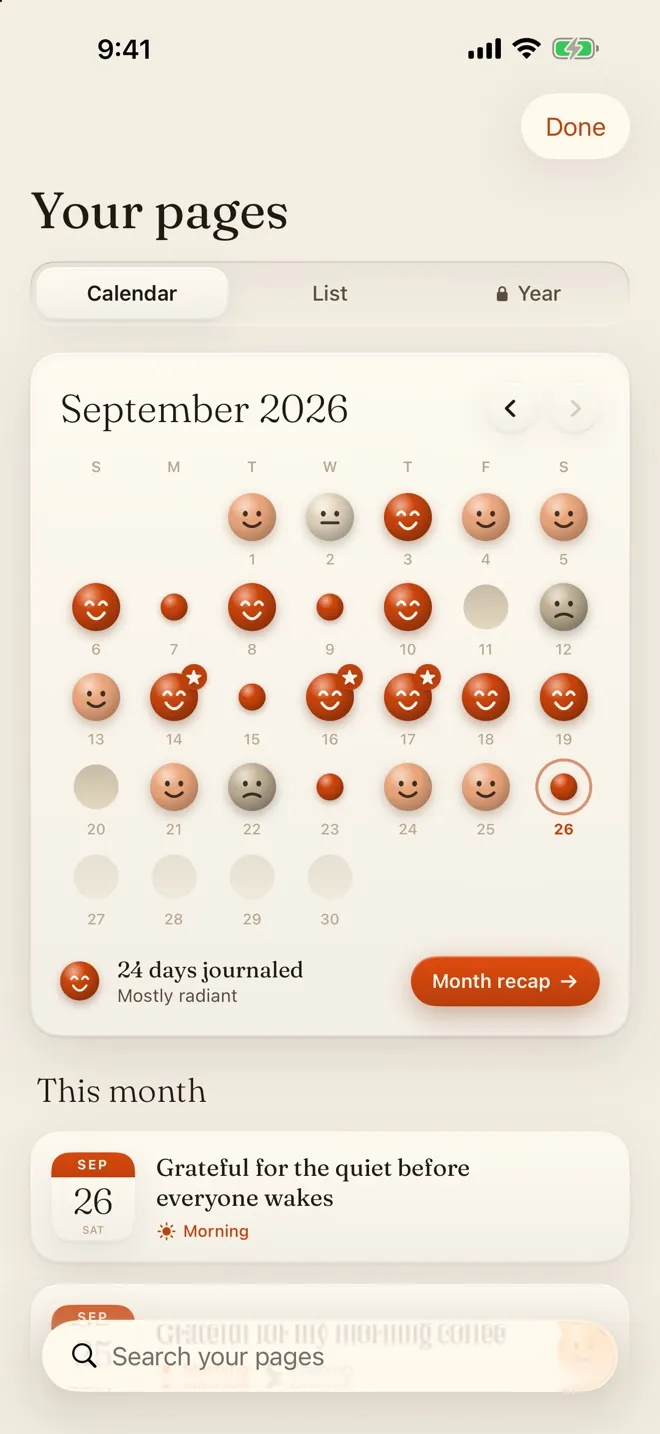
That's the structure Dawnbook is built around. The mood calendar fills one face a day, and optional tags like slept well, moved or friends show you, over time, which ones line up with your brighter days.
What should you write on a bad day?
Less than you think. On a low day, the goal is to keep the thread, not to perform gratitude. A few things that help:
- Log the mood first. Being honest that the day was rough takes one tap and removes the pressure to pretend.
- Go small. "The shower was hot" counts. So does "I made it to bedtime."
- Look back instead of forward. Rereading good things from brighter days is often easier than inventing new ones. Dawnbook does this for you: on a low or rough night, it shows three good things you wrote before.
What if you miss a day?
You will, and that's fine. Habits survive missed days; they don't survive guilt. Dawnbook's streak includes a grace day every week for exactly this reason. If you miss a whole evening, a one-tap mood from the widget still counts as showing up.
The short answer
If you only have room for one habit, start with whichever you'll actually do. But if you want to both feel better and understand why, do both. Done together, they take about five minutes a day.
Curious how a private journal can stay free? Read why Dawnbook charges once instead of every month.
Try it in Dawnbook
A free, private gratitude journal and mood calendar. Five minutes a day, no account, no ads.